There is nothing to state here, I'm afraid. Nothing that has not been stated perviously on other blogs. Although I see some classmates like Unforgiven, I'm afraid I'm in the minority. It's not that it's a bad film or anything like that, and it's not that I'm a close-minded reviewer, the kind who appraises one genre but totally lambastes another. It's just that I never gravitated to this film. The atmosphere is well-done, and one can see there was a (short) resurgance of western films in the 1990's. I've read someplace that this is one of only three Westerns to ever win Best Picture, and I respect Mr. Eastwood for this. However, this is not a blog for opinions. If I wanted to merely give out opinions, I would merely be a gossip columnist, not a credible reviewer.
"Angel", in this movie, can go both ways; it can describe a beautiful, saintly person, or some powerful, awestrucking creature that can take you to your doom. The latter applies to the encounter between Delilah and Will Munny. Delilah is not a bad looking person by any means; it's just that the bartender's too cruel to her, and I'm glad he finally got shot in the end. It sounds sadistic like that biased Hollywood Moral Code of the Hayes days, but I always wished he would get it from the way he handled the situation. The other meaning of "angel" also applies to Delilah because she is the only prostitute who doesn't suggest revenge or murder. It's Silky and Alice who come up with the idea.
The last remarks go out to the Kid and Munny's survival. I always thought the Kid was too chicken to actually kill those five men like he said he did, but when he confesses to the fact, he comes off as human instead of some punk. If he didn't get Munny involved, if he didn't kill the last of the two cowboys, he would be as useless as Buck Logan in Runaway Train. I personally didn't mind Buck, but the Schoffield Kid bothered me more than Buck ever could - and Buck is a rapist as far as we know.
Unlike our four previous films, the protagonist never dies; however, his morals do. William Munny controlled himself quite nicely throughout the film, considering he's been hired to be an assassin. However, Ned's death is where he draws the line. Even though Claudia was supposed to make him into a changed man, Munny reverts into his normal self and kills off almost everyone in the entire bar - including the aforementioned barkeep and Little Bill. The film would have had Munny killed off in one glorious showdown, but instead, he gets his revenge and Little Bill gets an unceremonious send-off. In a way, the film both avoids yet goes along with the existentialist formula that somebody must die: Although Ned is merely a supporting character, Munny's restaint dies along with him.
As for the upcoming reviews, I have one for A Streetcar Named Desire under way, even though I have no eloquent way of putting it yet. I also have plans for The Cabinet of Dr. Caligari, M, Metropolis, and Midnight Cowboy, and I may possibly do a review of Forrest Gump or Gone with the Wind, if it's possible. As for the next movie, I have absolutely no idea what it is. All that I know is that it's a noir film, and although I'm unfamiliar with the genre, I have seen a few films and I think it's a worthy genre, considering noir for me is Rififi and Who Framed Roger Rabbit.
Sunday, November 28, 2010

Sunday, November 21, 2010
Unforgiven (Part 1) - Our Story Begins

With that our of the way, Unforgiven is our next film, starring Clint Eastwood, longtime actor, western film veteran, and fitness enthusaist. It's set in Wyoming (one of the Great Plains states) in the early 1880's. Normally, most Westerns would be set in an arid, desert state like Texas or California and let the audience figure out the dates for themselves. However, the movie includes historical references and specific guns to make a clearer setting.
To get into the plot itself, we open to a brothel and a man cutting up (and possibly attempting to rape) a prostitute. Westerns have always featured prostitutes, but up until now, they were mostly can-can dancers or bar maids. They never did their actual jobs or made any references to what they were. One theme in the film is property, and another is vengeance. They go hand-in-hand when Delilah's pimp and Little Bill decide the cowboys' fates, and instead of being hanged or horsewhipped like the other girls demanded, he's promised twelve horses. It should've been assault or attempted murder, but instead, it's a matter of destroyed property.
Little Bill's priorities are also skewered. He kicks English Bob to a pulp because of how he treats his Chinese rail-workers, yet he always caters to corrupt businessmen. Corruption's another theme in the movie, as well as whether or not people can change. Even though William Munny apparently used to be an outlaw, it's love that sobers him up and makes him settle down. Where All Quiet in the Western Front, Citizen Kane, and The Seventh Seal make love seem like such a futile, useless thing, it's actually a force of healing in this movie. Like Eastwood's later films, this one deals with a man's relationship with his former wife and how he tries to move on. He doesn't only come back for the money, but also as some kind of warped chivalry. Little does he know reports about Delilah are greatly exaggerated...
Maybe the pimp will get a bullet in his head. Maybe Little Bill and Munny have some kind of past with one another. Maybe Munny will find out the truth about Delilah's damage. It's up to the film to decide all that.
P.S. I was wrong about English Bob; Little Bill just wanted to prove a point. Also, $1000 in 1881 would amount to $21,952.73 today. They must've been very good prostitutes or they're excellent money-savers.
Thursday, November 18, 2010
The Seventh Seal (Part 2) - Death and the Soldier
There is nothing much to remark here. However, I just wish to say that the ending fit the tone of the film; even though the idea of dancing with Death is grotesque, Bergman utilizes the final shots to create hope for the minstrels. They are the artists, the ones who escaped Death, but as they sang in one of their songs, "Death is on the shore". It follows everyone around and strikes without warning; he doesn't give a damn about your plans or your relatives. He just wants your Soul.
In most cases, Death is merely a skeleton in a black robe. In this movie, on the other hand, he is merely a deathly pale man; if the movie had not been so famous, Death would have been mistaken for a severe monk. The class may not have caught this, but He was there in disguise when the witch is about to die; luckily for her (and for the audience), she dies before the flames even lick her feet. Now, this film is low budgeted, so not everything is on such a grand scale; however, this does not distract from the quality. On the contrary, a modest budget fits a modest subject. Not to mention it would have been jarring if the entire film was in color.
Though not as analytical as before (I'll probably go back to it and change it), I just wish to get a few points across for now. In the meantime, I'm not sure how I feel about Unforgiven yet, but that's another story.
In most cases, Death is merely a skeleton in a black robe. In this movie, on the other hand, he is merely a deathly pale man; if the movie had not been so famous, Death would have been mistaken for a severe monk. The class may not have caught this, but He was there in disguise when the witch is about to die; luckily for her (and for the audience), she dies before the flames even lick her feet. Now, this film is low budgeted, so not everything is on such a grand scale; however, this does not distract from the quality. On the contrary, a modest budget fits a modest subject. Not to mention it would have been jarring if the entire film was in color.
Though not as analytical as before (I'll probably go back to it and change it), I just wish to get a few points across for now. In the meantime, I'm not sure how I feel about Unforgiven yet, but that's another story.
Sunday, November 14, 2010
The Seventh Seal (Part 1) - Death and the Soldier

Even though the film has a slow first act, it serves as exposition into the lives of Sir Antonius Block, his helper Squire Jons, and the minstrel couple Mary and Joseph, who are also parents. The story is set in the background of Sweden during the twelfth century, when it was undergoing the Black Plague, one of the deadliest pandemics the world has ever seen. It was a time of subjugation, of paranoia, of doubt. It was also a time of renewed values and, in its own special way, enlightenment. It's up for debate whether or not this was when the true Renaissance occured, since the Renaissance we know revived Roman styles while the Medieval times had a Gothic style of its own. There is also this tidbit that the term "Middle Ages" was coined to make fun of the era, as if it were the dark ages. However, we are not here to discuss history. We are here to debate life, death, and whether or not we have the answer for everything under the sun.
Normally, Death is a skeleton wearing a black robe and armed with a scythe. Instead, he is merely a pasty-faced man; he is unarmed, but he has his wits. Many a blogger already commented about his appearance and how he picked the "black" side for the game. Darkness is an unpleasant feeling; being in the dark is when we do not know anything about the situation; to wear black is to be mournful, and to be feeling black is to feel ominous. With this in mind, the color black symbolizes Death's mysterious nature. Sometimes, he comes at a bad time, while at others, he is relief. He also reminds our protagonist "It's not reality you see, but another kind". There are different truths, different views. In this time and age, nothing is ever as it seems.
Squires are expected to be only slightly educated, but Squire Jons' worldview is ahead of his time. He sees through religious zealotry and hypocrisy and despises a "war so stupid, only an idealist could've thought it up". While everyone else is fearful or even remorseful at the flagellants' march, he shows a look of indifference. He can't believe how people could "take that drivel seriously" and even makes himself clear to Antonius Block about it; it's daring on his part, especially when the Church may've thought he was being heretical. Unlike his master, who seriously wants to believe God is listening, Jons is our existentialist hero. He is not as extreme as Katchinsky or even Manny, but he still has a sour view of humanity.
I'm afraid it's a little early to discuss the minstrels' roles. However, Mary and Joseph seem more hopeful than our other leads. At least, for right now anyway. What we know so far is that they have a son named Michael, who is a toddler around this time, and that their manager lives with them. They are, in most other respects, normal people living normal lives. There is little to speak about, except for the fact Joseph constantly has visions and that Mary may have some hidden skeletons. Note how they react when the flagellants disturb their show. The way they panicked, they must've thought the priests have come to break up the gaiety. Festivities were allowed in the Middle Ages, but the Church mostly frowned upon these kind of things.
Maybe Death may strike one of the lovers or take their son, maybe Death may be up to his old tricks with Sir Block, and maybe Squire Jons will be more daring. Until then, let us hold our breaths for tomorrow. This entry may be shorter and not as deep as usual, but hopefully, there will be more to come.
P.S. In response to what some of the other bloggers are saying, I don't mind the subtitles or the fact it's in Swedish; it's better than listening to an English dub any time.
Sunday, November 7, 2010
Runaway Train (Part 4) - The Passion of Oscar Manheim
Now that this deadly tale is finished, I wish to close with some remarks.
I've been told that this was "one of the most underrated film in the 1980's," and it is. The cinematography is brilliant, the atmosphere is top-notch, and we have an iconic ending that couldn't be done differently if anyone tried. In a situation like this, the film could have ended with the front of the train crashing and bursting into flames. Instead, Konchalovsky's crew let Ranken and Manny go out in dignity and let the viewers think for themselves.
Though some people complain about Eric Roberts and his character Buck and how over-the-top Manny becomes, it's no surprise that they turn out the way they do after years in prison. Did anyone expect them to be calm, cool, considerate men? Manny is much brighter than Buck is, but as time goes on, he becomes a border-line lunatic. In the end, he keeps his principles and he goes out the way he always wanted to - a free man who has fulfilled his revenge against society. If they had been innocent men who have been wrongly convicted instead of the criminals they are, it would have attracted a wider audience and more appeal from critics at the time; it would have killed the entire message and tone of the story, but it would have been much more successful than it already is. Then again, unrecognised genuises are always rewarded in the end, and this is one of those instances.
I also have some slight beef with the Academy Awards website's descriptions. In the section for "Best Supporting Actor" in 1985, the writers describe Buck as Manny's "vicious convict co-escapee". If he were truly vicious, he would have killed and raped Sara on the spot. Instead, he helps her out on a couple of occasions. It is daring on the writers' part that he is a rapist. In any other situation, he would have been depicted as the villain and have no redeeming quality whatsoever. As Mr. Bennett told us, rape is the only crime that is never okay to commit. It's true that Buck is lasvicious, it's true that he is hedonistic, and it's true that he is lackadaisical. However, Sara is compassionate to him and then she bites Manny in the hand when they fight each other. Humanity itself is incredibly complex. We all have our best and worst traits; it just depends on how we handle them. To go against what the Academy Awards description implies, he is a patsy compared to the villain. As our protagonists suggest, Ranken is a hypocrite; he tries to make himself a pillar of moral strength, but in reality, he is an overgrown bully (and a closet sadist).
Going back to the ending, it is incredibly well-done. Manny is enigmatic as he stands over the engine in triumph and Ranken is defeated once and for all. Although existentialist at heart, the movie has religious themes from the very beginning. The penitentiary represents Hell, the prisoners are Christ's followers, Ranken and the guards are Satan and his minions, Buck is Peter, Sara is Mary Magdalene, Frank Barstow is Ponctius Pilate, the rail control booth are the Pharisee judges, Jonah is God, and Oscar "Manny" Manheim is Jesus Christ. As the title of this post suggests, Manny and Ranken's off-screen deaths represent Christ's crucifixion and his sacrifice to mankind. Like the apostles before them, Buck, Sara, and the prisoners are incredibly melancholy about the situation, but only God and Jonah knew that it was meant to be.
Even though Ranken and Manny "are both scum", Ranken is much worse than Manny. Unlike our protagonist, Ranken never risks his life to get what he wants. Instead, he sends somebody else to do the job. He feels no remorse when one of the officers get killed, and he only goes after Manny himself as a last resort. The way he reacts to being chained up also shows what kind of man he is: a sorry, snivelling, self-pitying coward. He is "as afraid to die as anyone else", and all he wants to do is prove he is more powerful than Manny. His response? "What's the difference?"
Life waits for no one. Fate waits for no one. It doesn't give a damn about what station we have in life, what role we play in our societies. The only thing that counts is if you live for yourself or if you live for others. This may not have been easy to stomach when it first came out. I do not blame them. It is a bleak message, but it is better to be selfless and honest than it is to be selfish and hypocritical.
Unlike Citizen Kane and All Quiet on the Western Front, Runaway Train will be on my mind for perhaps an entire month. It is certainly surpasses All Quiet on the Western Front, and it certainly blows Citizen Kane out of the water. Maybe the next film will surpass this one; maybe it won't. Let's wait until Monday or Tuesday to find out. I wish to know your opinions, if you have any. Let me know what I've missed.
P.S. Even though it may be childish, I keep on imagining what kind of books the characters might read. Buck might skim through Playboy, Sara could read the King James Bible, Jonah and Manny could've indulged in Nietzche's works, Ranken could have gotten his advice from Machiavelli's Morals of the Prince, and Barstow and the rest of the control members could have read The Complete Idiot's Guide to Running a Train Station. It's just some random thoughts.
I've been told that this was "one of the most underrated film in the 1980's," and it is. The cinematography is brilliant, the atmosphere is top-notch, and we have an iconic ending that couldn't be done differently if anyone tried. In a situation like this, the film could have ended with the front of the train crashing and bursting into flames. Instead, Konchalovsky's crew let Ranken and Manny go out in dignity and let the viewers think for themselves.
Though some people complain about Eric Roberts and his character Buck and how over-the-top Manny becomes, it's no surprise that they turn out the way they do after years in prison. Did anyone expect them to be calm, cool, considerate men? Manny is much brighter than Buck is, but as time goes on, he becomes a border-line lunatic. In the end, he keeps his principles and he goes out the way he always wanted to - a free man who has fulfilled his revenge against society. If they had been innocent men who have been wrongly convicted instead of the criminals they are, it would have attracted a wider audience and more appeal from critics at the time; it would have killed the entire message and tone of the story, but it would have been much more successful than it already is. Then again, unrecognised genuises are always rewarded in the end, and this is one of those instances.
I also have some slight beef with the Academy Awards website's descriptions. In the section for "Best Supporting Actor" in 1985, the writers describe Buck as Manny's "vicious convict co-escapee". If he were truly vicious, he would have killed and raped Sara on the spot. Instead, he helps her out on a couple of occasions. It is daring on the writers' part that he is a rapist. In any other situation, he would have been depicted as the villain and have no redeeming quality whatsoever. As Mr. Bennett told us, rape is the only crime that is never okay to commit. It's true that Buck is lasvicious, it's true that he is hedonistic, and it's true that he is lackadaisical. However, Sara is compassionate to him and then she bites Manny in the hand when they fight each other. Humanity itself is incredibly complex. We all have our best and worst traits; it just depends on how we handle them. To go against what the Academy Awards description implies, he is a patsy compared to the villain. As our protagonists suggest, Ranken is a hypocrite; he tries to make himself a pillar of moral strength, but in reality, he is an overgrown bully (and a closet sadist).
Going back to the ending, it is incredibly well-done. Manny is enigmatic as he stands over the engine in triumph and Ranken is defeated once and for all. Although existentialist at heart, the movie has religious themes from the very beginning. The penitentiary represents Hell, the prisoners are Christ's followers, Ranken and the guards are Satan and his minions, Buck is Peter, Sara is Mary Magdalene, Frank Barstow is Ponctius Pilate, the rail control booth are the Pharisee judges, Jonah is God, and Oscar "Manny" Manheim is Jesus Christ. As the title of this post suggests, Manny and Ranken's off-screen deaths represent Christ's crucifixion and his sacrifice to mankind. Like the apostles before them, Buck, Sara, and the prisoners are incredibly melancholy about the situation, but only God and Jonah knew that it was meant to be.
Even though Ranken and Manny "are both scum", Ranken is much worse than Manny. Unlike our protagonist, Ranken never risks his life to get what he wants. Instead, he sends somebody else to do the job. He feels no remorse when one of the officers get killed, and he only goes after Manny himself as a last resort. The way he reacts to being chained up also shows what kind of man he is: a sorry, snivelling, self-pitying coward. He is "as afraid to die as anyone else", and all he wants to do is prove he is more powerful than Manny. His response? "What's the difference?"
Life waits for no one. Fate waits for no one. It doesn't give a damn about what station we have in life, what role we play in our societies. The only thing that counts is if you live for yourself or if you live for others. This may not have been easy to stomach when it first came out. I do not blame them. It is a bleak message, but it is better to be selfless and honest than it is to be selfish and hypocritical.
Unlike Citizen Kane and All Quiet on the Western Front, Runaway Train will be on my mind for perhaps an entire month. It is certainly surpasses All Quiet on the Western Front, and it certainly blows Citizen Kane out of the water. Maybe the next film will surpass this one; maybe it won't. Let's wait until Monday or Tuesday to find out. I wish to know your opinions, if you have any. Let me know what I've missed.
P.S. Even though it may be childish, I keep on imagining what kind of books the characters might read. Buck might skim through Playboy, Sara could read the King James Bible, Jonah and Manny could've indulged in Nietzche's works, Ranken could have gotten his advice from Machiavelli's Morals of the Prince, and Barstow and the rest of the control members could have read The Complete Idiot's Guide to Running a Train Station. It's just some random thoughts.
Thursday, November 4, 2010
Runaway Train (Part 3) - Sara's Entrance, Cabin Fever, and Rising Insanity
No one can expect all my predictions to be correct; the railway worker barely comes out in one piece, but we finally get to meet the fourth major character and how crazy Ranken has become. There are hardly any words to say what it is I have to say, but I want to make myself as clear as possible.
First off, about Sara, it's a breeze of fresh air that she's not conventionally attractive. In the movies nowadays, you see a lot of women all dolled up, even when it doesn't fit in with the situation. If the acting's good enough, the audience avoids such things, but most of the time, it's jarring to the viewer. In Sara's case, she's actually a normal person, not some statuette to oogle over. Like Buck and Manny, she has grime and dirt all over her face, and her clothing is practial. Note that there is absolutely no make-up on her whatsoever. In fact, she looks like a tomboyish young girl with her heart-shaped earrings and her braided pig-tails. Please don't think me shallow, dear readers; I NEVER judge people by their looks. I just wanted to bring this up in light of current times. There is much more to Sara than that.
As we already know, Sara is one of the railway workers, and like our protagonists, she has been stranded. With her expertise, a first-time viewer could have mistaken her as a deux ex machina, the one who could possibly put a stop to the runaway train. This is not to be. The train is as unstoppable as circumstance. Our heroes can try to eliviate their situation, but most of the time, it's all for naught. At least it goes a little slower, but not slow enough.
We also see another side of Buck, Manny, and Ranken. Obviously, none of them are perfect; two are convicts, another is a crooked cop. All the same, old habits die a slow and painful death. Buck obviously never lays a hand on Sara, but there's still a chance he might. He's the one who suggests helping her when we first see her, and he is the one who pulls himself together and rescues her when she nearly falls onto the tracks. Then again, I wouldn't really trust a man if the first question he asks me is "You wanna ****?" You fill in the asterisks for yourself.
Speaking of Buck, I think Sara has a crush on the guy. This sounds immature, but she always stands up for him whenever Manny insults him. After all, even though Buck's not right in the head, he is still vulnerable. It'll do him a lot of good to tell him he's "so brave" (even though Manny is more than eager to disagree). This is also just another inference, but he may have had an abusive childhood at one point. He mentioned being in reform school and he has a lackadaisacal approach to everything, yet when Manny gets cabin fever and pummels him, I can't help but feel sorry for the poor guy. He is merely an overgrown child, in need of some consensual love. His expression after the fighting ends is one of shock, of disappointment, of shattered hopes. It's clear he had few idols in his life. Manny "was a hero... to all of [the prisoners]", yet his attack is the ultimate betrayal. Going back to Mr. Bennett's theory, if Manny is the Messiah, his fellow prisoners are his disciples, Buck is his right-hand man, and Sara is Mary Magdalene. He wants to help, but he is incapable at the moment. At the moment, Manny becomes his own Judas, but this may be a little early to make assumptions.
When I was reading Frankenstein in Mrs. Johnson's English Class freshman year, we discussed feminine and masculine balance, and in the film's case, Sara represents sympathy and sanity in an otherwise mad world. She also believes "there are miracles", which don't even calculate in Manny's mind, and definitely not in Ranken's. It's clear that Manny is getting frostbite and going insane now. Cabin fever could do that to absolutely anyone. However, the madman inside him breaks out and he nearly beats him to death. Note that Sara is the one to talk them out of fighting. Manny has become "an animal", a man "willing to sacrifice someone else's life instead of [his] own." It's going to take a lot to make up for what's happened, but at least he threw out the knife.
Ranken has also gone nuts. There is no cabin fever, no attacks, so there is no reason for him to be the way he is. The only thing Barstow has done is tell him to wait... and then he gives him a "swirly" - in his own piss! It's unprofessional if I say I was absolutely disgusted by this scene... and we had to see it twice... Even though it's cringeworthy, the film smashes all sympathy we could've have for Warden Ranken. It's hard to be a warden at a high-security prison; the pay is lousy, the prisoners are lunatics, and you have to keep a level head at all times. Normally, I would have had some kind of respect for the man, but now it's gone.
It's a very interesting film, and now that Ranken knows where they are, I want to see how it plays out. Will they get out alive? Will Ranken catch up with them? Will the railway company safely stop the train? It's up to the viewer to decide.
First off, about Sara, it's a breeze of fresh air that she's not conventionally attractive. In the movies nowadays, you see a lot of women all dolled up, even when it doesn't fit in with the situation. If the acting's good enough, the audience avoids such things, but most of the time, it's jarring to the viewer. In Sara's case, she's actually a normal person, not some statuette to oogle over. Like Buck and Manny, she has grime and dirt all over her face, and her clothing is practial. Note that there is absolutely no make-up on her whatsoever. In fact, she looks like a tomboyish young girl with her heart-shaped earrings and her braided pig-tails. Please don't think me shallow, dear readers; I NEVER judge people by their looks. I just wanted to bring this up in light of current times. There is much more to Sara than that.
As we already know, Sara is one of the railway workers, and like our protagonists, she has been stranded. With her expertise, a first-time viewer could have mistaken her as a deux ex machina, the one who could possibly put a stop to the runaway train. This is not to be. The train is as unstoppable as circumstance. Our heroes can try to eliviate their situation, but most of the time, it's all for naught. At least it goes a little slower, but not slow enough.
We also see another side of Buck, Manny, and Ranken. Obviously, none of them are perfect; two are convicts, another is a crooked cop. All the same, old habits die a slow and painful death. Buck obviously never lays a hand on Sara, but there's still a chance he might. He's the one who suggests helping her when we first see her, and he is the one who pulls himself together and rescues her when she nearly falls onto the tracks. Then again, I wouldn't really trust a man if the first question he asks me is "You wanna ****?" You fill in the asterisks for yourself.
Speaking of Buck, I think Sara has a crush on the guy. This sounds immature, but she always stands up for him whenever Manny insults him. After all, even though Buck's not right in the head, he is still vulnerable. It'll do him a lot of good to tell him he's "so brave" (even though Manny is more than eager to disagree). This is also just another inference, but he may have had an abusive childhood at one point. He mentioned being in reform school and he has a lackadaisacal approach to everything, yet when Manny gets cabin fever and pummels him, I can't help but feel sorry for the poor guy. He is merely an overgrown child, in need of some consensual love. His expression after the fighting ends is one of shock, of disappointment, of shattered hopes. It's clear he had few idols in his life. Manny "was a hero... to all of [the prisoners]", yet his attack is the ultimate betrayal. Going back to Mr. Bennett's theory, if Manny is the Messiah, his fellow prisoners are his disciples, Buck is his right-hand man, and Sara is Mary Magdalene. He wants to help, but he is incapable at the moment. At the moment, Manny becomes his own Judas, but this may be a little early to make assumptions.
When I was reading Frankenstein in Mrs. Johnson's English Class freshman year, we discussed feminine and masculine balance, and in the film's case, Sara represents sympathy and sanity in an otherwise mad world. She also believes "there are miracles", which don't even calculate in Manny's mind, and definitely not in Ranken's. It's clear that Manny is getting frostbite and going insane now. Cabin fever could do that to absolutely anyone. However, the madman inside him breaks out and he nearly beats him to death. Note that Sara is the one to talk them out of fighting. Manny has become "an animal", a man "willing to sacrifice someone else's life instead of [his] own." It's going to take a lot to make up for what's happened, but at least he threw out the knife.
Ranken has also gone nuts. There is no cabin fever, no attacks, so there is no reason for him to be the way he is. The only thing Barstow has done is tell him to wait... and then he gives him a "swirly" - in his own piss! It's unprofessional if I say I was absolutely disgusted by this scene... and we had to see it twice... Even though it's cringeworthy, the film smashes all sympathy we could've have for Warden Ranken. It's hard to be a warden at a high-security prison; the pay is lousy, the prisoners are lunatics, and you have to keep a level head at all times. Normally, I would have had some kind of respect for the man, but now it's gone.
It's a very interesting film, and now that Ranken knows where they are, I want to see how it plays out. Will they get out alive? Will Ranken catch up with them? Will the railway company safely stop the train? It's up to the viewer to decide.
Wednesday, November 3, 2010
Runaway Train (Part 2) - The Body Count Rises
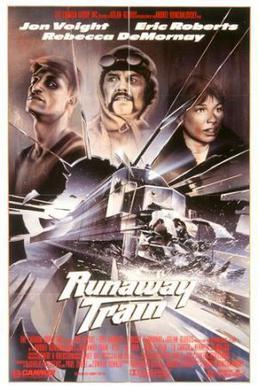
Anyway, as one can see from the post title, there are more casualties, even though not as graphic as in the opening scenes. We never actually see them die, but one thing's for certain. The film takes no prisoners (no pun intended).
Buck, as I see it, never really experienced life the way Manny did; as much as he denies it, he's just "a punk", a lazy, cowardly one who never thinks things through. Why else does he keep worrying about dying, going into a sewer, and having a lousy pair of shoes? The boy's a one-track mind. Obviously, the guy's incredibly short on brains, and he complains so much about his feet, I'm surprised Manny held back until the moment they talk about their plans after the ordeal ends. I thought he was in jail for being a petty theif, but statutory rape's even worse. Their ideals clash in a scene worthy of an Academy Award. While one crook wants to fritter away his fortune on wine, women, and song, the other wants to make a decent living. It works not only because of the chemistry between the two actors, but also because of timing and visceral energy. Manny's idea of holding "on to that job like gold because it is gold" and his clear-cut language indicates that he may have been a upper-middleclassman who may have fallen on hard times, and Buck's responses show that he likes to feed off thrills and live for the moment. Manny thinks things through, while Buck does not.
Mr. Bennett keeps on calling Manny a killer, and it's true that he was involved in one of the prisoners' deaths, but he's still no killer. However, I can agree that they represent Jesus and Jonah; calling Manny the Messiah may be a bit of a stretch *(I almost expected the Warden to come out screaming "He's not the Messiah! He's a very naughty boy!"), but I can see how Buck could be the Jonah archetype, the one who gets swallowed by a whale and changes for the better, so to speak. I'm not sure if anyone else noticed this, but now that we're talking about religion, the telephone (telegraph?) poles represent crosses. Just my two cents.
The iron train itself represents fate. No one can stop it as it surges down the tracks, bringing its passengers for the ride and destroying anything that gets in its way. Our lives, the movie says, are a runaway train. As much as others may try to keep it in check, it is up to us how we handle the situation. The engineer may be dead, the passengers on the caboose may be pushing daisies, and the rail-worker may soon bite the dust, but the train waits for no one. Another blogger also observed that it could represent Manny. Both have an iron will, both are larger than life, and both have lived through the good and the bad. They are also hard to control, as shown with the frantic exchange between the railway company members and Manny's interaction with Warden Ranken.
If Ranken wasn't the head of the prison, he would have been one of its inmates. He is sadistic, he is calculating, and he always has ulterior motives. By plotting the escapees' deaths and confiding "[Manny] would do the same thing I would do", he is on his way to being a murderer. Unlike our protagonists, he has more power than they will ever know. I don't think we wanna know what kind of "fun" he's talking about.
The last remark is just a little something on Eddie, one of the honchos of the railway company. He must be an incredible dunce! Of COURSE the passengers should know about the runaway! OF COURSE they should've worked harder to stop that train!
Sorry about that. The man obviously has no experience in running a railway company. His ethics are unsafe and uncouth. All he cares about is the money. Unfortunately, a lot of businessmen are like that. They care for no one but themselves.
Maybe we'll be introduced to DeMornay's character tomorrow. Maybe the railway worker doesn't get killed in the collision. One thing's for certain. The poster at the start makes the trio look incredibly ghostly; there are no bright colors involved. The only areas with the most lighting are Manny and the titular runaway train, which says a lot if one reads my entire post. We'll see how everything works out.
*Reference to Monty Python's Life of Brian
Monday, November 1, 2010
Runaway Train (Part 1) - Of Violence and Close-ups
I have lived through Nightmare on Elm Street, I have seen Hellraiser, I have went through the Tooth Fairy, and I have survived Candyman. Each of these featured excessive violence, yet whenever I'm confronted with films like Inglourious Basterds, I can't help but feel a little nauseous. It's not that the movie was bad; on the contrary, it wasn't. Every scene was a shoot-out, every scene featured beatings, scalpings, and blood. Runaway Train happens to fit in the Inglourious Basterds category.
Now, Mr. Bennett told us the opening scenes are the most violent ones out of the entire movie, so maybe it won't delve into Quentin Tarantino territory; Tarantino is too extravagant anyway. The film itself has a very promising start so far as we are introduced to Eric Roberts' character, Buck, a prisoner from the South who looks like he's roughly in his mid-to-late twenties. Runaway Train takes place in Alaska, and the cinematography is brilliant! The story is represented like it is a documentary; most films from the 1980's have either violet lights or a bluish tinge; in Runaway Train's case, everything is in a jarring yellow. This isn't supposed to be the feel-good film of the year. In fact, there is no music at all. Everything is grounded in realism; even the jail cells are not stylized.
It is a man eat man world, and to paraphrase Mr. Bennett, it is a Greek tragedy. There is no way a film that opens with a prison riot can end well. We are also introduced to our actual protagonist Manheim, otherwise known as Manny. Do not let his hardened exterior fool you; he is a learned man who knows precisely how the world works. He is a cold-blooded killer, yet he is also philosophical. How many prisoners can quote Nietzche?
One of Nietzche's philosophies, as a matter of fact, is the story's theme. "Whatever doesn't kill me makes me stronger" underlines Manny's determination to break free. The prison itself is squalid, and the warden walks like he is a dictator. Instead of trying to reform the criminals, he merely regards them as animals and barely intervenes when there is a riot. It'll be a stretch to call him Hitler, Stalin, or Mussolini; he is not that monstrous. If his charges weren't prisoners, perhaps the viewer may draw the comparisons.
This is where I want to truly get into violence. Prison films always feature at least some form of riot, be it over money or relationships. In this case, it is not provoked at all. Now that I think of it, I see why it is more uncomfortable compared to the other films mentioned in the first paragaph. In Hellraiser and Candyman, the actual violence happens off-screen; even though the antagonist in the former movie bludgeons two of her victims to death, the actual blows are never shown. Runaway Train, on the other hand, does not back down on any punches. We have an extreme close-up of Manny's hand when he gets hand, and then we get some religious imagery when he is stabbed in the side. These extreme close-ups do not help anyone either. Obviously, the production team used a fake hand to get the job done, but it looks so visceral, so realistic, you can't help but look away. This is not a beautiful film, and it is never meant to be. Oddly enough, these never kill him, which goes back to Nietzche's quote. As stated before, he is a hardy man who refuses to back down without a fight.
We were cut off before Buck and Manny continue their escape, but already, I see a foil between the two personalities. Buck seems more ambitious, while Manny plans everything carefully. He is the brains of the operation, the one who keeps a level head. Buck, on the other hand, seems more impulsive, and he takes matters more lightly than he does. In short, he is a lackadaisical man.
Let us see what's in store for us on Wednesday, when we continue on with the rest of the film. Maybe we'll get to meet Rebecca De Mornay's character, and maybe we'll see the warden's reaction to their escape.
Now, Mr. Bennett told us the opening scenes are the most violent ones out of the entire movie, so maybe it won't delve into Quentin Tarantino territory; Tarantino is too extravagant anyway. The film itself has a very promising start so far as we are introduced to Eric Roberts' character, Buck, a prisoner from the South who looks like he's roughly in his mid-to-late twenties. Runaway Train takes place in Alaska, and the cinematography is brilliant! The story is represented like it is a documentary; most films from the 1980's have either violet lights or a bluish tinge; in Runaway Train's case, everything is in a jarring yellow. This isn't supposed to be the feel-good film of the year. In fact, there is no music at all. Everything is grounded in realism; even the jail cells are not stylized.
It is a man eat man world, and to paraphrase Mr. Bennett, it is a Greek tragedy. There is no way a film that opens with a prison riot can end well. We are also introduced to our actual protagonist Manheim, otherwise known as Manny. Do not let his hardened exterior fool you; he is a learned man who knows precisely how the world works. He is a cold-blooded killer, yet he is also philosophical. How many prisoners can quote Nietzche?
One of Nietzche's philosophies, as a matter of fact, is the story's theme. "Whatever doesn't kill me makes me stronger" underlines Manny's determination to break free. The prison itself is squalid, and the warden walks like he is a dictator. Instead of trying to reform the criminals, he merely regards them as animals and barely intervenes when there is a riot. It'll be a stretch to call him Hitler, Stalin, or Mussolini; he is not that monstrous. If his charges weren't prisoners, perhaps the viewer may draw the comparisons.
This is where I want to truly get into violence. Prison films always feature at least some form of riot, be it over money or relationships. In this case, it is not provoked at all. Now that I think of it, I see why it is more uncomfortable compared to the other films mentioned in the first paragaph. In Hellraiser and Candyman, the actual violence happens off-screen; even though the antagonist in the former movie bludgeons two of her victims to death, the actual blows are never shown. Runaway Train, on the other hand, does not back down on any punches. We have an extreme close-up of Manny's hand when he gets hand, and then we get some religious imagery when he is stabbed in the side. These extreme close-ups do not help anyone either. Obviously, the production team used a fake hand to get the job done, but it looks so visceral, so realistic, you can't help but look away. This is not a beautiful film, and it is never meant to be. Oddly enough, these never kill him, which goes back to Nietzche's quote. As stated before, he is a hardy man who refuses to back down without a fight.
We were cut off before Buck and Manny continue their escape, but already, I see a foil between the two personalities. Buck seems more ambitious, while Manny plans everything carefully. He is the brains of the operation, the one who keeps a level head. Buck, on the other hand, seems more impulsive, and he takes matters more lightly than he does. In short, he is a lackadaisical man.
Let us see what's in store for us on Wednesday, when we continue on with the rest of the film. Maybe we'll get to meet Rebecca De Mornay's character, and maybe we'll see the warden's reaction to their escape.
Subscribe to:
Posts (Atom)